
The following sermon was preached by Rev. Dr James Kellerman in the seminary’s Martin Luther Chapel for the divine service on the Festival of St Matthew, Apostle and Evangelist, 21 September 2023.
Jesu, juva!
Beloved in Christ, we know how the Apostle Paul felt about the day when our Lord met him on the road to Damascus. We have three accounts of the event in the book of Acts alone, two of which come directly from Paul’s lips. Paul also alludes to the event frequently enough in his epistles so that we could figure out its significance, if not all the details, from those passages alone. He described it as a day “when he who had set me apart before I was born, and who called me by his grace, was pleased to reveal his Son to me, in order that I might preach him among the Gentiles.”
Similarly, when Andrew met Jesus, he told his brother, “We have found the Messiah.” Philip said nearly the same thing: “We have found him of whom Moses in the Law and also the prophets wrote.” And Nathaniel eagerly confessed to Jesus the impression he had made upon him: “Rabbi, you are the Son of God! You are the King of Israel!” When Christ got into Peter’s boat, taught a crowd, and then provided Peter and his friends with a miraculous catch of fish, he was so overwhelmed that he said, “Depart from me, for I am a sinful man, O Lord.”
But what did Matthew think or feel on his big day? All he records is that Jesus called him to follow him, and he did. If we read between the lines, we might gather that Matthew was thrilled by the call, for the next thing we read is that Jesus “reclined at table in the house.” Presumably, it was Matthew’s house, although he doesn’t directly say so. Luke had to clarify that it was Matthew himself who hosted the dinner, as we had guessed. Matthew is very reticent about all these details, almost as if he is uncomfortable recording more than the most essential facts of the event.
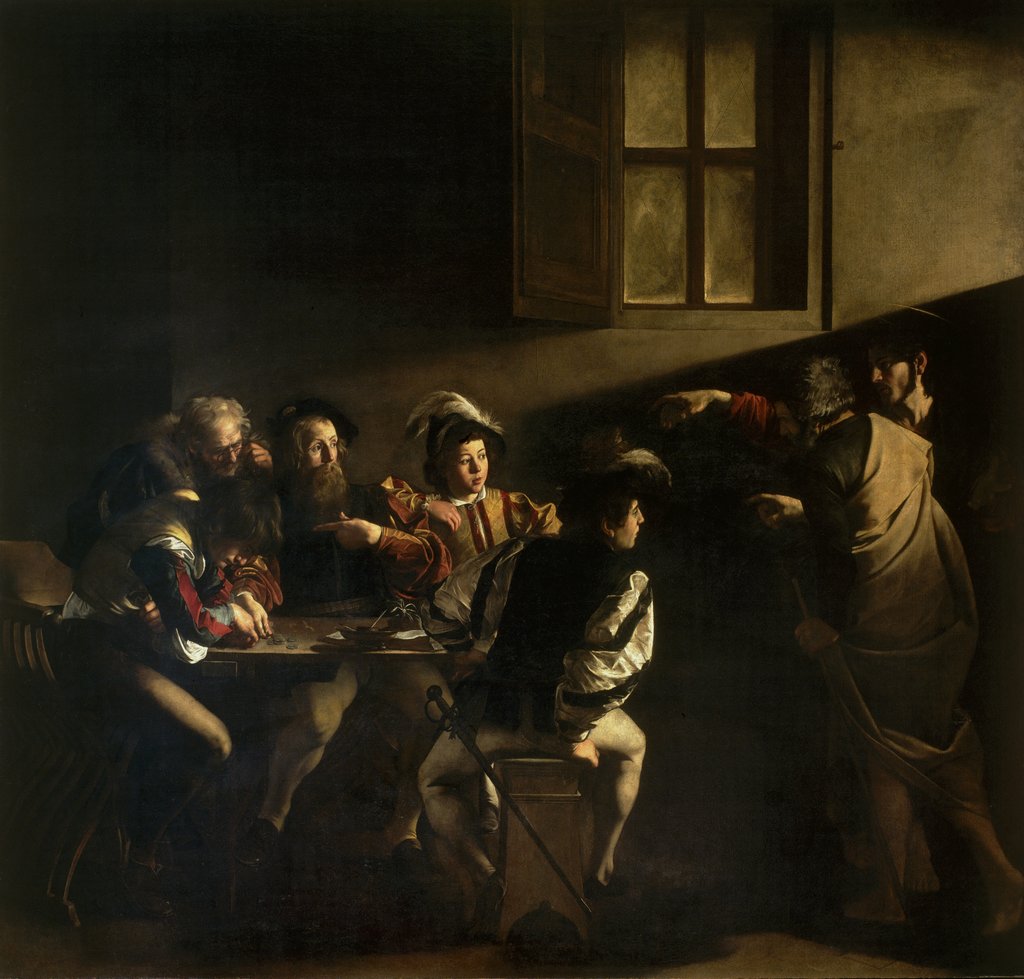
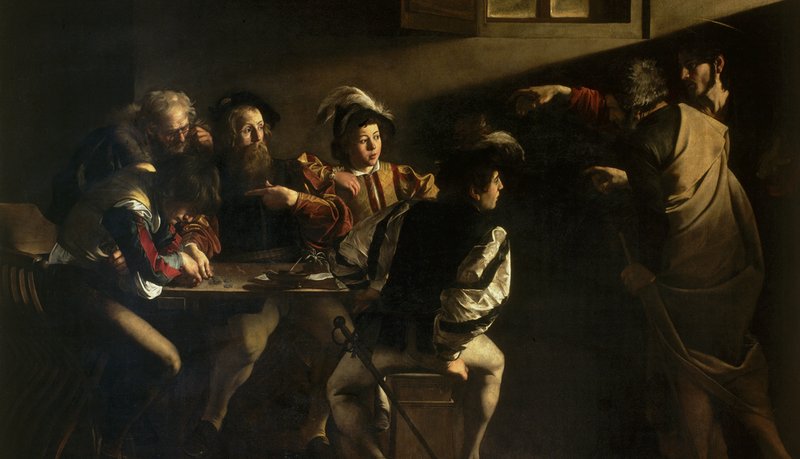
However, we would like to know more, wouldn’t we? Perhaps the best portrayal of the astonishment and joy that must have filled Matthew upon his call was made by the painter Caravaggio. He is one of those artists like Michelangelo or Rembrandt who are known by one name only. I must admit he did not lead the most savoury of lives. He was the stereotypical late Italian Renaissance artist who painted many religious scenes but was not an altogether pious son of the church. Regardless, there is much for us to ponder in his painting The Calling of St Matthew. You will find a copy of it in the worship insert, as well as a full-colour plate in the art book in the narthex.
The most obvious feature in the painting is a flabbergasted Matthew, pointing to himself as if to ask, “Who, me?” Matthew, understandably, is the central figure among the five individuals upon whom the light falls in the bottom lefthand corner of the painting. But he is not alone, just as God’s grace was not meant only for the twelve apostles. To the left of Matthew are two men who don’t realise that anything special is happening because they are too busy greedily counting the day’s take. To the right are two young lads who had appeared in an earlier painting of Caravaggio called The Card Sharps. In that painting they had cards tucked away in their clothing, ready to be pulled out when needed. But in this painting, they are curious about what is happening. Will they too heed the call to repent of their sins? Will they too follow Jesus, not as apostles, to be sure, but as part of God’s faithful people?
Our eyes instinctively gravitate toward the bottom lefthand corner because the figures there are illuminated by the light. But it is worth thinking about the other three quadrants. The top half is largely empty except for the light coming from the upper right corner. Without it, the bottom left quadrant would not be lit up. There is a window in the top of the painting, just right of centre, but the light is not coming through it. Matthew is not being called by the natural light of reason or his own willpower. He has not grown disgusted with his greed and resolved to find a better way, wherever it might lie. The fact that so much of the painting is devoted to the light itself rather than to the people upon whom it is cast indicates that Matthew is not the main character of the story.
The main character stands in humility, in the shadows. He alone wears a halo, for he alone is holy. But rather than frighten Matthew, Christ veils himself in lowliness and issues a gentle call. His face is somewhat lit, but what really stands out is his hand. It is directed toward Matthew but is not firmly pointing at him as you might expect it to. It takes just a moment’s reflection before you realise that you have seen that pose of the hand before. It is the same gesture painted by a different artist (Michelangelo) in a different church in Rome. There, in the ceiling of the Sistine Chapel, Adam takes the same pose with his left hand (the weaker hand) as God reaches out to him with his right hand (the hand of power). Here we have the mirror image. Jesus Christ, the Second Adam, reaches out with his right hand in the same gesture, restoring Matthew to his true humanity after he had let it be deformed by a lifetime of greed. It is a human hand but a hand with the full power of God behind it.
There is one other figure in the painting. He is the one with his back toward us. He too points toward Matthew and his friends. The index finger is tauter than in Christ’s hand. In fact, he is making a gesture of accusation. He is one of the Pharisees who is upset because Jesus ate “with tax collectors and sinners”.
The Pharisees loom larger in today’s Gospel than does Matthew himself. Sure, Matthew heard the call and heeded it. That takes up one verse. The banquet was filled with other “tax collectors and sinners”. That takes up another verse. But the final three verses are dedicated to the debate between Jesus and the Pharisees over his associating with people like Matthew. The Pharisee may not be in the limelight in Caravaggio’s painting. In fact, he does not seem to notice God’s light at all, for he is looking away from it. All he sees is Matthew bathed in the light, not the light itself, just as the Pharisees saw sinners, not God’s grace. Moreover, the man is blocking our view of Jesus. For the accusation that Jesus is wrong in associating with people like Matthew implies that Jesus is not holy enough to be our teacher, let alone our Saviour.
Our Lord responded that the sick, not the healthy, need a physician. Our Lord came not for the respectable, for people who had no sins to confess and no wicked flesh to struggle against. Such people, if they existed, could save themselves. Rather, Christ came for those who had been waylaid by Satan and dragged down into the gutter of sin. He “came not to call the righteous, but sinners.”
This was no new plan of God. The Lord had told the prophet Hosea, “I desire mercy, and not sacrifice.” Well, that is the Greek way of putting it. The Hebrew called it not “mercy” but “steadfast love,” a word more commonly predicated of God than of human beings. It is God who shows steadfast love to all people, including to such people as Matthew and his tax collector buddies. If God shows such love, then we too can show mercy and steadfast love to these people with whom God longs to be reconciled.
Therefore, beloved in the Lord, what exactly was going through Matthew’s mind when he heard the call of the Lord? We don’t know, not in a detailed way, although Caravaggio’s portrayal rings true to life. But, more importantly, we know what was going through our Lord’s mind. He was calling someone suffering from a dire spiritual illness. Indeed, he was bringing back to life someone who was spiritually dead. He was welcoming a sinner that he might receive the righteousness of God. He was showing mercy and doing so in a way that would lead to his supreme sacrifice on the cross, where he gave what his Father most desired: a sacrifice that was pure mercy. And he shows that same tenderness and steadfast love to us, whom he calls to be part of his church and to be his disciples. In Jesus’ name. Amen.
SOLI ☩ DEO GLORIA
Discover more from Concordia Lutheran Theological Seminary
Subscribe to get the latest posts sent to your email.
 Concordia Lutheran Theological Seminary