
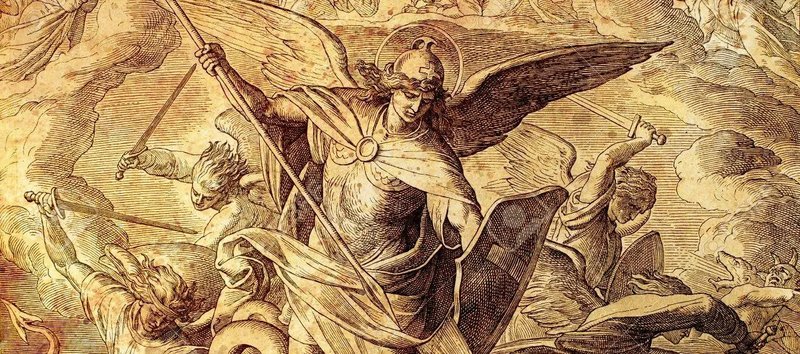
The following sermon was preached by Dr Thomas Winger in the seminary’s Martin Luther Chapel for the divine service on the Festival of St Michael and All Angels (transferred to 28 September 2023). The text is Luke 10:17-20.

Dear brothers and sisters of our Lord Jesus Christ: Almost every year our chapel life begins with three festivals: Holy Cross Day (14th Sept.), St Matthew (21st), and St Michael and All Angels (29th). Now, Dr Kellerman, guardian of the historic lectionary, will be most pleased if I find some logic in this sequence. Of course, these three festivals weren’t deliberately ordered this way, since there were independent reasons why each found its date. But let me humour him by suggesting something’s going on here.
We begin with the foundational event of the Christian faith: the death of Christ by which this God-Man brought reconciliation between His heavenly Father and sinful humanity. The cross is the central symbol of our faith, standing at the front of every church, with Christ’s body prominently displayed, as Paul declared: “we preach Christ crucified” (1 Cor. 1:23). This is how Christ won the victory over sin, death, and the devil. But how were we to know of His death (and resurrection) unless God caused it to be written? St Matthew, Apostle and Evangelist, was a designated witness to Christ’s death who received a divine commission to write down the Gospel account for the church of all time. Together with the other apostles, Matthew was sent forth to call the world to repentance and faith in Jesus, thus giving birth to the Holy Church. But just as Christ was attacked by the Evil Foe from the moment of His birth, driven down to Egypt for His safety, so also the Church, His Body, has been harried and hounded by the ancient Dragon throughout her earthly pilgrimage—as we heard in our Epistle reading. So the festival of St Michael and All Angels, those shock troops of God’s heavenly army, reminds us of the ongoing state of war in which we find ourselves. This is the theological sequence of Paul’s letter to the Romans, from the atoning death of Christ in chapters three through five, to its delivery by Baptism in chapter six, and then the militant Christian life in chapters seven and eight. This is the sequence of Ephesians, from the reconciling work of Christ on the cross in chapter two, to the work of the holy ministry in chapters three and four, to the great heavenly armour bestowed on the baptised in chapter six, “For our struggle is not against blood and flesh, but against the rulers, against the authorities, against the world powers of this darkness, against the spiritual [forces] of evil in the heavenly [places]” (Eph. 6:12).
From St Michael’s Day to the end of the Church year we’re focussed on the end times; but since the end times came upon us already at Christ’s resurrection, we could view these final weeks as the time of the Church in concentrated form; this is our time. This festival reminds us that holy angels stand with us in these dark days in all three of their divinely given tasks: to worship, to proclaim, and to fight. From the moment of their creation, they were formed to surround God’s heavenly throne with their His praises. And this they continue to do as they’re even now assembled visibly with the saints above and invisibly with the saints here below. “Praise Him, all His angels; praise Him, all His hosts!”, the Psalmist cries, “Let them praise the name of the Lord! For He commanded and they were created” (Ps. 148:2, 5). The angels, whose very name means “messenger”, were sent at each critical moment in God’s plan to deliver His promises to His people, as they declared to Abraham and Sarah that she would miraculously bear a child in her old age, and as they delivered to Joseph and Mary the message that the Son of the Most High would enter the world through Mary’s untouched womb. And the angels are God’s mighty warriors, who at His command can wipe out His enemies with a sweep of their hands, as the angel of the Lord struck down 185,000 men in the Assyrian camp (2 Kgs 19:35).
These are the mighty works of God’s angelic hosts, who praise His name with thunderous voices, who proclaim His works with divine words, and who defeat God’s enemies with divine power. But if they have such strength, why don’t we see it in action? This is the anxious cry of suffering saints who feel alone in their worship in ever more empty churches, who watch people walking by in oblivious deafness to God’s Word, who feel and see the persecution of Christians by demonic forces who rampage at will. If one angel can defeat an army, why can’t myriads of angels deal a swift and deadly blow to Satan’s entire army, whom they outnumber, outrank, and outpower? There are at least two good answers to those difficult questions, both of which flow from God’s way of working in this world. For, firstly, God works in and through human beings. As God wears us like masks to accomplish His purposes, even though it makes Him appear weak and fragile, so also He orders His angels to work under and alongside mankind. The angels accomplish God’s will indirectly as they worship, proclaim, and fight. Our worship is accompanied by “angels, archangels, and all the company of heaven”, but rather than elevating us to the glory of heaven above, they descend to stand alongside us here below. They submit to the humble human way of worship in words and created things. They fill out our choir and strengthen our voices as they sing not just the songs of heaven, but join our human hymns. They don’t preach God’s Word by their whim and will, but rather stand with the pastors God has placed in His church, as the seven letters of John’s Revelation, addressed to the “angel” of each church, testify. In our Gospel reading, Jesus sees Satan fall from heaven like lightning when His 72 ministers proclaim repentance and the forgiveness of sins. God’s angels do battle with the devil’s forces through the Word of God, the sword of the Spirit, wielded by pastoral soldiers. Just as Gandalf and his fellow wizards, who in Tolkien’s mythology were god-like figures with supernatural power, just as they were forbidden to engage the enemy Sauron in direct conflict, but were required to support the humble efforts of mortal men and hobbits, so also the angels are forbidden to use their mighty power in open battle, but are placed by God into the service of His church. They limit the devil’s attacks; they make him play by God’s rules; but they let God’s plan play out.
For God’s plan was to win victory in a topsy-turvy way, the way of the Incarnation itself. God sent not myriads of angelic troops, but rather a small and weak human child. The child grew into a man; but the man refused to use strength against His enemy. Instead He pursued victory by way of weakness. As He sternly rebuked Peter on the night of His betrayal, if He had wished to use the way of power, He could simply have called on His Father to send twelve legions of angels against His enemies (Mt. 26:53). But Jesus chose not to win by the sword. He defeated the devil with the Word of God, which proceeded like a sharp, two-edged sword from His mouth (Rev. 1:16). He defeated the devil by seeming to be defeated Himself, by suffering and dying, by shedding not the enemy’s blood but His own. And through this rearguard attack He caught the devil entirely off guard. The devil, who was rejoicing to see his foe laid in a tomb, was suddenly struck silent by the glorious appearance of the resurrected Lord in His underground fortress.
God’s way of salvation in Christ isn’t what we expect it to be; but it is as He would have it. So also the angels are what God made them to be, not what we would have them be. We celebrate the gift of the holy angels best when we give thanks for how God has chosen to use them. His will is that they would work in hidden and indirect ways. They don’t preach and worship for us, but stand alongside us in our worship and proclamation. They don’t fight the battle for us—indeed, Christ has already fought it and won. But they stand with us on the battle field, lifting our drooping arms when we’re tired of holding up the shield of faith and the sword of the Spirit’s Word. And so we can stand firmly, neither lonely nor afraid, surrounded by such a host.
For this, now and in days to be,
Our praise shall rise, O Lord, to Thee,
Whom all the angel hosts adore
With grateful songs for evermore. Amen (LSB 522:8).
Discover more from Concordia Lutheran Theological Seminary
Subscribe to get the latest posts sent to your email.
 Concordia Lutheran Theological Seminary