

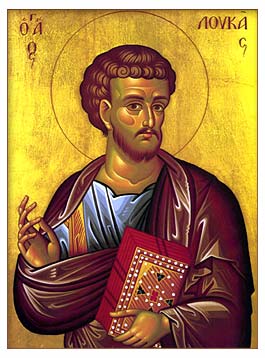
The following sermon was preached by Dr James Kellerman in the seminary’s Martin Luther Chapel for the divine service on the Festival of St Luke, Evangelist, 18 October 2023. The text is Luke 10:1-9.
Beloved in Christ, we do not know any of the names of the seventy-two sent out by our Lord in today’s gospel. Someone in the fourth century suggested that one of them might have been Luke, but it is an idea too clever by half. If Luke had wanted to make a cameo appearance, he would have done what he did in Acts: he would have switched from “they” to “we”, subtly hinting thereby that he was an eyewitness and participant of what he was narrating. But he did no such thing when he wrote today’s Gospel.
So the seventy-two remain anonymous. In that respect, they are like most pastors. We can name the man who was bishop of Hippo in the early fifth century or the bishop of Seville in the early seventh century. (They are Augustine and Isidore, for those keeping score at home.) But can you name even one parish pastor in these dioceses from the same era? Not likely. Most ministry is done in obscurity. You may be much beloved by your parishioners, but in a couple decades after leaving you will be just a name in an anniversary booklet and a photo on the wall—and eventually only a name on a tombstone.
But pastors who are unknown to later history do most of the pastoral work. This is how the Holy Spirit has chosen to guide and bless the church so that she can flourish and grow. And so we at the seminary rightly learn from the seventy-two what the ministry is that we exercise or are being trained to exercise. Some of the instructions pertain only to the brief mission of the seventy-two. They are not permanent mandates for the ministry, just as your vicarage instructions will be different from those given at your ordination. On the journey that the seventy-two were undertaking, packing light made sense, but today pastors may own more than one shirt, even if all their shirts are black.
But the basic task remains the same. The seventy-two were sent into a hostile world. So are we. The seventy-two were “lambs in the midst of wolves”. So are we. Pastors enter a world that would be happy to chew them up and spit them out again.
That is because the world does not know peace. Everybody insists on having things his or her own way. Eventually, everyone’s ambitions and wants collide with those of other people. Then, everybody jockeys for power. The matter is settled either by brute force or at least the threat of making some people’s lives miserable. Even when people do not use violence to get their aims, plenty of people are always still left unhappy by the way differences have been settled.
It is into this sort of world that pastors are given a word to say: “Peace!” Pastors impart peace, a point Luke makes clear throughout his gospel. In the opening two chapters of his gospel, he has four canticles that all touch on why Christ was born. In three of them, there is a reference to peace. Zechariah proclaimed that the Lord has come “to guide our feet into the way of peace”. The angel choir sang “And on earth peace among those with whom he is well pleased.” And Simeon said, “Lord, now you are letting your servant depart in peace.” In short, these canticles heralded Christ’s coming as the breaking out of peace here on earth.
Peace is more than the absence of war. It is a full restoration of the harmony and well-being in which God designed us to live. It is not a mere sentiment. It is something that is objectively true. It is the peace and wholeness that exists in our relationship with God. Peace has to start with him, for he is our Creator. If we have no peace with him, we cannot be at peace with ourselves or with other people. Whatever sort of truce we might broker with others or even inside of us quickly falls apart under pressure. For ultimately there is no honour among thieves. Rebels against God will always rebel against others, too. Only if we have peace with God do we have the prospect of a lasting peace.
God’s peace not only delights us, but it transforms us, as well. Misery entered the world because we turned away from God and began waging war against him. Now that he has brought about peace between himself and us, the miseries of our warfare have come to an end. It is now time for the healing to begin.
The damage done during a war does not go away in an instant, simply because two nations have signed a peace treaty. It takes a while for the rubble to be cleared and new buildings to be constructed. No matter how sincerely the two nations might embrace peace, it doesn’t quite feel like peace as long as the scars of war remain. In the same way, the damage done by our sin still remains, even though we are now at peace with God. Yes, he looks at us with favour, justifies us by his grace, and fully absolves us. But we and all creation still groan because we do not yet see our full adoption as God’s children but only our “bondage to decay” and our “subjection to futility”.
Perhaps we experience the aftermath of our former warfare most in our bodies. It is easy for us to overlook how the world around us is no longer a pristine Eden, but it is harder to ignore our own pain and the deterioration of our bodies. It is no surprise, then, that one of the ways Christ brought peace during his earthly ministry was by healing. Matthew, Mark, and Luke all describe how Christ forgave a paralysed man and then healed him. The bodily healing demonstrated that his words of forgiveness were no mere pious wishes but the real thing. Later, we read that our Lord commissioned the apostles and the seventy-two not just to proclaim God’s peace and his kingdom, but also to heal during their brief missionary travels. “Luke, the beloved physician,” was quick to notice this, and he commends the Great Physician for the healing our Lord himself did as well as for the healing which he commissioned others to do in his name.
Here we might squirm a little bit. We know our Pentecostal friends are quick to lay hands on people and command them to be healed. They believe that they are as powerful healers as Jesus was in his earthly ministry. Then, if someone does not get better, they blame the individual for not having enough faith. But as we read the Scriptures carefully, we see a much more nuanced picture. Even as the Apostle Paul, the great apostle of faith, healed many people, he himself suffered from at least one incurable malady. And so we might be tempted not to talk about healing at all.
But you do not have to be a Christian for a long time to see that God heals people in response to our prayers. Pastors perhaps notice it more than others, but it is no secret. Healing is never automatic or mechanical. Sometimes God grants healing, and sometimes he does not. But the times that he grants healing or prolongs life amaze. One of my former parishioners, who should have died of stage four lung cancer within six months of his diagnosis, is still alive and kicking today, five years later. The cancer has not gone away but has stabilised. On a smaller scale, how many times have we ourselves prayed for and been granted a quick return to health—far speedier than we or anyone else expected?
This healing is but a sign of what Christ is doing as he brings the fullness of God’s reign into our midst. Our bodily healing in this life is partial and at best lasts until we are placed in the grave. It is but the down payment on the full healing that will occur on the Last Day, when God shall fully heal and restore not just our bodies but the entire heavens and the entire earth. This healing will manifest the peace of God that shall prevail for all eternity.
This is the healing and the peace that our good physician friend, Luke, wrote about it. It was the healing and peace that the unnamed seventy-two brought and that the countless throng of pastors continue to bring to the church today. In Jesus’ name. Amen.
Discover more from Concordia Lutheran Theological Seminary
Subscribe to get the latest posts sent to your email.
 Concordia Lutheran Theological Seminary