
The following sermon was preached by Dr Thomas Winger in the seminary’s Martin Luther Chapel for the divine service in celebration of The Purification of Mary and the Presentation of Our Lord, 2 February 2024. (Its timely publication was unfortunately delayed.)
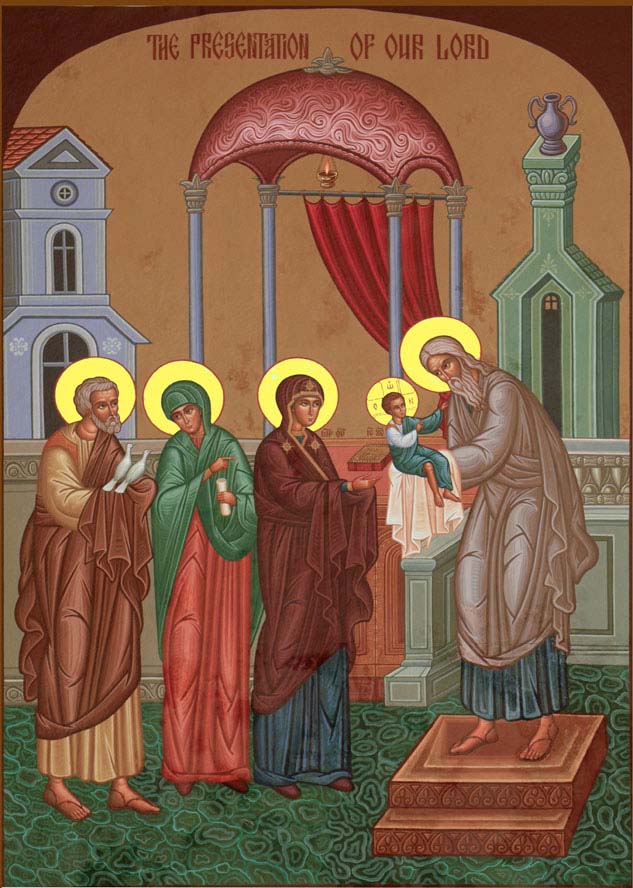
Dear brothers and sisters of our Lord Jesus Christ: “The Purification of Mary and the Presentation of our Lord” tops the league table as longest title for a festival in the LSB liturgical calendar. And so it presents the preacher with, on the one hand, a veritable cornucopia of rich fare for a sermon; but, on the other hand, a dilemma. The first-year homiletics student is wisely warned not to stuff the fragile frame of his first sermon with everything he’s learnt about a text, or with every theme the festival provides. There will be another occasion, and another, to preach the text, and a few arrows should be held back in your quiver. Seasoned preachers often resolve the dilemma by focussing on one verse, or perhaps even one word. But a greater and more rewarding challenge is to look for what holds it all together. What golden thread runs across the Lukan tapestry that pictures these two events?
Consider Mary, the Mother of our Lord, who had first responded faithfully to the angel’s message by saying, “Behold, I am the servant of the Lord; let it be to me according to Your Word” (Lk. 1:37). This day she replied with similar faithfulness to the instruction of the Torah which said:
2 … If a woman conceives and bears a male child, then she shall be unclean seven days. … 3 And on the eighth day the flesh of his foreskin shall be circumcised. 4 Then she shall continue for thirty-three days in the blood of her purifying. … 6 And when the days of her purifying are completed, … she shall bring to the priest at the entrance of the tent of meeting a lamb a year old for a burnt offering, and a pigeon or a turtledove for a sin offering, 7 and he shall offer it before the LORD and make atonement for her. Then she shall be clean from the flow of her blood. …. (Leviticus 12)
The maths are simple enough: seven plus thirty-three is forty. Christmas was forty days ago today. We remember today the conclusion of Mary’s little Lent, and the formal closure of the Christmas season. But there’s more. There’s a ritual of uncleanness and purification here that’s so foreign to contemporary, practical sensitivities, that we have difficulty seeing anything more than an arbitrary and misogynist regulation. Why should the natural flow of blood experienced by a new mother sever her relationship with God, such that she can’t enter His house or participate in His worship?
Well, first we must overcome our instinct to judge our relationship with God by what we do. Foul and evil deeds certainly offend God’s holiness. But what offensive deed had a new mother like Mary committed? She, more than any mother, had received her child as God’s gift and borne it in faithfulness to her calling. The answer lies in following that trail of blood. For, on the one hand, “the life of the flesh is in the blood” (Lev. 17:11). And so bleeding signifies death. And the blood of childbirth sends us back to Genesis, the curse, the labour, the pain, and the entrée of death into the world. The mother needs purification not because of what she’s done, per se, but because of who she is, because in every childbirth the Fall into sin is recalled, and the need for atonement highlighted.
But let’s put Mary aside for a moment. Our text, most puzzlingly, speaks of “their purification”, presumably speaking of Mary and her Child. What was He doing there? Well, there was a word of Moses for the child to fulfil, as well. A price had to be paid. In this case, the price recalled not Eden but Egypt. For God had first exacted a high price from the Egyptian tyrants for enslaving His people: the lives of their firstborn, man and beast. Their blood was shed, in a sense, to set Israel free. And by way of perpetual reminder of the price that was paid, God laid claim on the firstborn of Israel.
12 “Behold, I have taken the Levites from among the people of Israel instead of every firstborn who opens the womb among the people of Israel. The Levites shall be mine, 13 for all the firstborn are mine. On the day that I struck down all the firstborn in the land of Egypt, I consecrated for my own all the firstborn in Israel, both of man and of beast. They shall be mine: I am the LORD.” (Num. 3:12-13)
And you know how it worked. Every firstborn child was presented ritually to the Lord at the Temple, so that there was no doubt about God’s claim on the child. Through purification and sacrifice, a substitution took place. The Levite took the child’s place in God’s house. The child was freed and went home.
There it is. The golden thread is gleaming. The mother, whose participation in the sin of Adam and Eve was graphically portrayed by her labour and blood, is freed from punishment by the substitution of a pair of turtledoves—no real substitute, but it worked because God said so. And a child, who belonged to the Lord because God had redeemed all Israel from slavery, was presented and freed by the substitution of another. The Law was fulfilled; God’s wrath was staved off. “Substitution” is the word of the day.
But it’s not the end of the story. It was, after all, an Old Testament regulation, and so it couldn’t go on for ever, as the letter to the Hebrews tells us. And there are two whopping pieces to the puzzle that we’ve deftly side-stepped up till now. For this mother was no ordinary mother; she was the Virgin, who could not be said to have participated in the sin of Adam and Eve by giving birth to that particular Child, conceived without sin. And the Child was Jesus, who needed no redemption for Himself, who hadn’t participated in the sin of Adam, or Israel’s misdeeds that led them into Egypt—who in fact was Himself the substitution, the firstborn Son of God. Joseph and Mary presented Him to the Lord not so that He might be redeemed by a Levite who dwelt in God’s house on His behalf, but so that He might dwell in God’s presence for their sake. And so that day the Law was “fulfilled” in new sense. Far from simply obeying it, this holy, innocent pair “filled it up” so that it never needed obeying again. A new kind of substitution was at work that ended all need for substitution. No sacrifice or Levite substituted for Him, but rather He substituted for them. And for us. He became our pair of turtledoves, our Levite. In Him we were all presented to the Lord and purified, made holy, acceptable to God, able (as today) to stand before Him in His house. It was a substitution literally to end all substitutions.
And so the liturgical puzzle of this apparently overburdened feast is resolved by the Gospel that ties together the purification of Mary and the presentation of the Lord—for us. But before we rest, one last thought. For there’s another substitution still at work. There’s the aged Simeon, the faithful and true Israelite, waiting in the Temple for the redemption of Israel. Through him we find ourselves in the tapestry’s picture, and its story is brought to us today. It was a stroke of genius when some early Lutheran church orders took Simeon’s song that had been used in the priest’s devotions (and in Compline) and gave it to the whole church to sing at after receiving Holy Communion. For in this service we are, of course, like him. The Child Jesus was not only presented to the Lord that day; He was presented to Simeon, and to us. Come now and take Him up in your arms. Experience what it is to be Simeon, and even to go beyond his experience by receiving Christ’s flesh and blood in your very mouths, to be united bodily with Him and His substitutionary death. “Depart in peace”, the pastor then says, echoing the aged saint’s faithful words. Your life is no longer required of you, but given back to you through His ever-living flesh, and life-giving Blood. Peace which the world cannot give. Amen.
Discover more from Concordia Lutheran Theological Seminary
Subscribe to get the latest posts sent to your email.
 Concordia Lutheran Theological Seminary
In Him we were all presented to the Lord and purified, made holy, acceptable to God, able (as today) to stand before Him in His house. It was a substitution literally to end all substitutions. It is good to remember that we have been purified, made holy, and are acceptable to God and can stand before Him in His house.